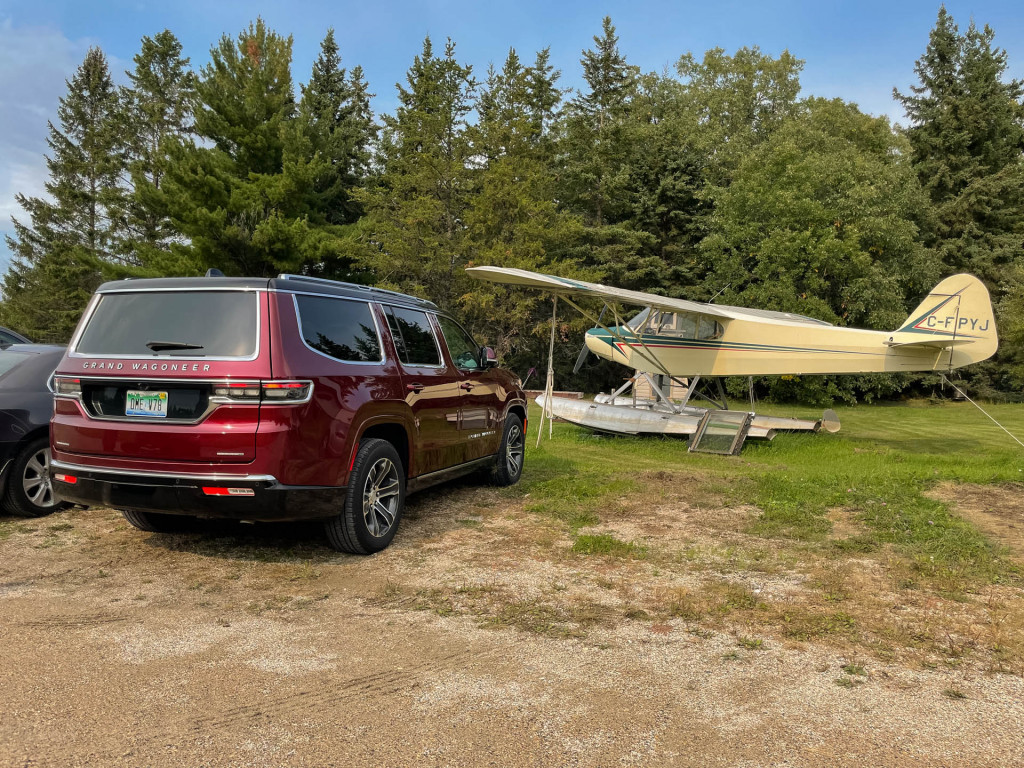
The folks from Stellantis don’t want everybody to call the Wagoneer a Jeep because the 21st-century Wagoneer is a luxury extension of the Jeep brand. Whatever the reason, despite the signature Jeep grille on the front, there are no signs of Jeep markings in it, making the Wagoneer range a separate entity or whatever the reason, much like the Mustang from Ford or the Corvette from Chevrolet.
As most people would say that the new Wagoneer runs on similar mechanicals as today’s RAM 1500, you would expect that it’s a tough cross-country machine built for all walks of life. Looks like they were right, almost. Because of such mechanicals, the new Wagoneer is offered as either a rear-wheel-drive or a four-wheel-drive with three different variations while the new Grand Wagoneer is offered only in the highest four-wheel-drive configuration, known as the Quadra-Trac II with rear eLSD and a 2.72:1 low-range gear ratio.
The Wagoneer is powered by a 5.7L V8 engine with eTorque that produces 392HP of power and 404lb-ft of torque. The Grand Wagoneer, meanwhile, is powered by the 6.4L V8 engine that produces 470HP of power and 455lb-ft of torque. They’re both mated to an eight-speed AT. In terms of towing, the normal Wagoneer can tow up to 10,000 lbs while the Grand Wagoneer, despite its powerful engine, can tow less than 10,000 lbs.