Repost: 18 Mar 2013
SEASON 2
“F” Bracket
F bracket results coming soon!
At the races last night, there was strong representation from all of the “Big 3”!

As expected, there was good, close racing among the competitors that showed up ready to race!

Repost: 18 Mar 2013
SEASON 2
“F” Bracket
F bracket results coming soon!
At the races last night, there was strong representation from all of the “Big 3”!
As expected, there was good, close racing among the competitors that showed up ready to race!
Repost: 3/19/13
SEASON 2
F Bracket
14.30-14.99 e.t. required to compete
History was made on opening night for FAPSD Season 2!
For the first time ever, two Ford products made the Top 4!
The Semi-Finals were between Driven1 and Camaroboy68SS.
Here are the results:
Race 1:
Camaroboy68SS, 14.312 e.t., Win
DRVN1, 14.314 e.t.
Race 2:
DRVN1, 14.314 e.t., Win
Camaroboy68SS, 14.331 e.t
Race 3:
DRVN1 14.28 e.t., Breakout
Camaroboy68SS, 14.34 e.t., Winner
4th place, DRVN1 1970 Ford Mustang Boss 429 SCJ

3rd Place, Camaroboy68SS, 1957 Chevrolet Bel Air with 283, fuel injection and PowerGlide?

P.S. Mopar fans, JFYI, the 1967 Barracuda broke out bad once, got tree’d once, and had a crappy night.
Some times you get the bear, and sometimes the bear gets you…
Guess that’s racing!
^
Repost: original on 3/19/13
SEASON 2
F Bracket Finals
14.30-14.99 e.t.
The Finals were a show down between Chevy and Ford!
KneeDeepInPink in the Chevrolet, and PineDirty in the Ford!
KneeDeepInPink came to town in the 1967 Chevelle SS396, with the L78 396 BBC
with 375HP and 4 speed!
Some believe the epitome of the classic muscle car is a GM mid-size!
Remember, Pontiac GTOs, Olds 442s, and Buick GS400s are 1st cousins of Chevelles.
However, there are others that would argue that classic muscle is best represented
by a muscular pony car!
PineDirty drove in on an immaculate Grabber Blue, 1971 Mustang Mach 1 featuring
a 429SCJ with 375HP!
Mustangs begat, and defined the term “pony car,” but some might call this
thoroughbred race horse a Clydesdale!
No matter what, this was a classic show down! Big block against Big block!
Brand C vs Brand F!

The results:
Race 1
PineDirty 14.383 E.T., Win
KneeDeepInPink 14.396 E.T.,
Race 2
KneeDeepInPink 14.26 E.T.
PineDirty 14.29 E.T., Win. PineDirty broke out the least amount.
2nd place

^
Repost: 3/19/13
SEASON 2
F Bracket Winner and Champion!
Congratulations PineDirty!
History was made tonight!
FAPSD had the first ever bracket champion driving a Ford!
Also, where else can you have this much fun and make money?
PineDirty had a $500K payday as the bracket winner!
Hey, PineDirty! Dont spend it all on one Ford…

^
Repost:
HISTORY
Tribute to the Shelby Super Snake GT500. Up for auction at Mecum Auction soon. This is 1968.
The original and only one is a 1967 model. Be pretty quick in the FAPSD series, huh?

info from:www.motorauthority.com
As Mustangs Daily tells us, a very significant 1967 Shelby GT500 Mustang is about to cross the auction block, at Mecum’s 26th Original Spring Classic auction on May 17. Originally intended as a demonstration vehicle for Goodyear’s “Thunderbolt” tires, a conversation between Carroll Shelby and Don McCain turned the car into much, much more.
McCain had been the sales manager for Shelby American, and he saw a potential market for cars even higher in performance than the Shelby GT500. Since Carroll Shelby had been in charge of Ford’s GT40 racing efforts, McCain convinced Shelby to stuff the 427-cubic-inch race engine from the GT40 into the GT500 reserved for tire testing.
Shelby engineer Fred Goodell was happy to comply, equipping the car with the sameengine used to win Le Mans in the GT40 Mk II. The end result was a Mustang with some 600 horsepower and a top speed of 170 miles per hour. Its name, coined by McCain, was to be the Shelby Super Snake.
The Goodyear tire test was a success, despite the fact that the whitewall Thunderbolt tires were the narrowest ever fitted to a Shelby GT500. After Shelby himself ran the car to 170 mph, Goodell averaged a speed of 142 mph for some 500 miles, proving the durability of the tires.


^
Repost: AD
Hi folks. Ready for more FAPSD racing?
E bracket is next! 13.60 e.t. is the index.
Sunday, March 24, 2013, 9:30pm EST
Hope to see you there!
Repost: Originally run 3/24/13
SEASON 2
E Bracket
13.60-14.29 e.t.
E Bracket was run last night.
Here are some of the racers…


DRVN1 and Robluvcars1

FLR JustInSane and PineDirty

I lov3 MY H*v2

KneeDeepInPink and oZwAnCoHdAyRoYu

Stay tuned for results!
Repost: Original post 10/24/13
HISTORY
“Old School Muscle” is the topic for today…
As many of you know, there were a few factory performance cars running around before
what is generally known as the “Golden Age” of the factory muscle cars. There is a common
belief that the muscle car era started in the late 50’s or early 60’s for factory performance cars.
However, there are some older factory cars that would defintely
qualify as muscle cars had they been built during the Golden Age.
Here are a couple of examples:
The Oldsmobile Rocket 88 coupe


oldsmobile rocket 88 picture
I like the longer sleeker rooflines of this body style, (below), over the more formal roof line (above).
There were several versions to chose from.
Jerry Sullivans custom 1949 Oldsmobile Rocket 88 ^^^^^
info courtesy of wikipedia:
The Oldsmobile 88 (a.k.a. Eighty-Eight) was a full size sold by the Oldsmobile division of General Motors and produced from 1949 until 1999. From 1950 to 1974 the 88 was the division’s top-selling line, particularly the entry-level models such as the 88 and Dynamic 88. The 88 series was also an image leader for Oldsmobile, particularly in the early years (1949–51) when it was one of the best performing automobiles thanks to its relatively small size, light weight and advanced overhead-valve high-compression V8 engine originally designed for the larger and heavier C-body, and more luxurious 98 series but it also replaced the straight-8 on the smaller B-body, and can be credited for creating what was considered the predecessor of muscle cars of the 1960s.
Oldsmobile introduced the 88 badge in 1949. It was named to complement the already-existing 76 and 98, and took the place of the Oldsmobile Straight-8 engined 78 in the model lineup. The new car used the same new Futuramic B-body platform as the oldsmobile Straight-6 engined 76 but paired it with the powerful new Rocket V8 engine. This combination of a relatively small light body and large, powerful engine made it a precursor to the muscle car. The Rocket 88 vaulted Oldsmobile from a somewhat staid and conservative car, to a performer that became the one to beat on the NASCAR (National Association for Stock Car Auto Racing) circuits. It won six of the nine NASCAR late-model division races in 1949, 10 of 19 in 1950, 20 of 41 in 1952, and was eventually eclipsed by the low-slung, powerful Hudson Hornet, but it was still the first real “King of NASCAR.” This led to increased sales to the public. There was a pent up demand for new cars in the fast-expanding post World War II economy, and the 88 appealed to many ex-military personnel who were young and had operated powerful military equipment.
Buck Bakers Nascar 1949 Olds Rocket 88

Specs/Performance:0-60: 13 secs. Top Speed: 97-100 mph. Engine: V8, 303 c.i., ohv, Horespower: 135 HP (conservatively rated) Torque: 283 ft/lbs.
Love to see this run in FAPSD against a Hudson Hornet?
Repost:
TUNER TOPIC
The original 1969 Camaro ZL-1!
1969 Chevrolet Camaro ZL1 Heads To Mecum Auction BlockRare 427ci COPO Car is #23 of 69 Units Ever Produced
By Sean Haggai, Photography by Mecum Auctions
Popular Hot Rodding, October 07, 2013
1969 Chevrolet Camaro ZL1 Drivers Profile
This largely original, well documented 9560AA 1969 Camaro ZL1 in Dusk Blue outfitted with the M21 4-speed, Hurst shifter and power front disc brakes is being offered at the Mecum Auction. Additionally, this GM exotic comes complete with the shipping report from Fred Gibb Chevrolet, Protect-O-Plate and a notarized affidavit from the original owner, which attests to the first 30 years of ownership history and mileage.
It’s difficult to hide excitement over the first-generation Chevrolet Camaros from 1967-1969. After all, it’s arguably the most sought after and beloved Camaros of all time. Make it a 1969 Chevrolet Camaro, the last year of that generation and enthusiasts are met with a rush of emotion unmet by any other make or model in GM’s arsenal of muscle cars. Mention, “Central Office Production Order,” COPO or ZL1 name in a crowd of hungry GM aficionados and you could be mobbed for information leading to it.
Quite frankly, these aren’t terms you just throw around at will. That said, perhaps the most collectible of all Camaros is the 1969 Chevrolet ZL1 Camaro. #23 (Lot S135.1) of 69 will be crossing the Mecum Auction block in Chicago, Illinois during the weekend of October 10-12, 2013. Let’s be honest here, folks. This Camaro is a wicked breed of which only 69 units were only produced in total for 1969 with the coveted all-aluminum 427. It is by far the ultimate example of what General Motors was producing during that era.
Carrying the COPO ZL1 name is serious business. So serious in fact the last 1969 Camaro ZL1 that crossed the Mecum block, #62 – a one of one red on red model – a handsome $530,000 was paid.
While the Can Am spec 427ci big-block was never meant for street-duty, Fred Gibb Chevrolet had other plans. Gibb’s plan involved stuffing a milder version on the engine including a single 4-barrel carburetor with the RPO designation ZL1. While these particular all-aluminum 427ci big-blocks swung a forged steel crank and rods, it weighed in at roughly the same as a traditional, iron 350ci small-block. What’s more, the 427ci delivered 430 horsepower on paper. However, claims of that number are actually in the 500+ horsepower range
1969 Chevrolet Camaro Specs
#23 of 69 ZL1 Camaros produced
COPO 9560AA
Documented with the Protect-O-Plate and shipper
Notarized affidavit from original owner attesting to the first 30 years of ownership
Scored 995 of 1000 at the Classic Chevrolet Club meet
Restored by Barry Burstein to original factory specifications
All-aluminum 427/430 HP ZL1 engine
M21 close ratio 4-speed manual with Hurst shifter
Power front disc brakes
Dusk Blue with Black bucket seat interior
Color keyed wheels with dog dish hubcaps
Goodyear Polyglas tires
Certified by the COPO connection
Though restored by Barry Burstein of St. Louis, Missouri, the noted COPO authority was able to restore #23 back to original specifications and has even been certified by the COPO Connection. Better than when it left the factory, this ZL1 even retains the painted steel wheels, dog dish caps and Goodyear Wide Tread F70-14 Polyglas tires.
Repost:
SEASON 2
E Bracket
13.60-14.29 e.t.
Semi-final Results
3rd on the podium in E bracket was DRVN1!

E bracket CHAMPIONSHIP Race.
KneeDeepInPink and FLR JustInSane went at it for the E Bracket title.
This car should look familiar to race fans. It was in the F bracket finals last week.
Heres the 1967 Chevelle SS396 driven by KneeDeepInPink. 375hp, 4 speed, and quick hands.
A change to a set of a lower rear gears made it quick enough for E bracket!

FLR JustInSane is a newcomer to the FAPSD series, but obviously the man has skills.
Right? He’s in the finals!
FLR JustInSane drove a Velocity Yellow 2010 Camaro SS.
That paint color kinda looks like “Tweety Bird” huh?

Results:
Race 1
KneeDeepInPink dumped the clutch and came out the hole hard! Maybe too hard.
Cause he ran out the back door.
Quick is usually good, but there are two things in life when it’s not good for a man to be too quick,
one is bracket racing…
In the other lane, FLR JustInSane aka “Tweety Bird” musta seen Sylvester the cat!
That Camaro was consistent.
Smooth and consistent. And Quick. He cut one of the best lights of the day!
KneeDeepInPinks hard running 396SS ran a 13.57 E.T. Breakout.
FLT JustInSane ran a fantastic race, with a 13.60 E.T.
Race 2
This is how it finished up.
KneeDeepInPink raced to a 13.585 and broke out. Always the bridesmaid, never the bride!
FLR JustInSane raced to a 13.634 to take the Win!

FLR JustInSane is the Winner of E bracket!
Congratulations to all the podium finishers! That was great racing folks!
Big Thanks to all that competed. See you next week for D bracket!
^
Repost: 10/13
HISTORY
The 1940 Ford V8
More old school factory muscle…
As most of you are aware, Ford Motor company was one of the first domestic manufacturers to offer to the general public, a mass produced, affordable, V8 powered automobile.
This V8 was known as a “flathead” due to the cylinder heads. It was made popluar by the 1932 Ford models, and millions were built and sold over two decades. Because it was good performer for its day, and the passenger cars it was installed in were considered fast, it was also notorious. It was the motor that powered the vehicle of choice by many of the criminal underworld and was used in numerous stolen “getaway” cars by gangsters, including Bonnie and Clyde. Of note, the 1940 Ford V8, was also used by southern “moonshiners” to outrun the law, when “making a run.” Dont even mention the thousands of hot rods that were built and used flathead Ford V8 power.
Over the years, a huge speed parts aftermaket was developed and still exits for the flathead Ford V8. Edelbrock, Ardun, were some of the big names in hi-po parts, that got a start by creating and producing hi-po flathead parts. Speedway Motors was and is still a big catalog supplier for the engine. The V8 engine has been used to break dozens of land speed records at Bonneville, and was also a foundation engine in the early years of NASCAR.
For many, the 1940 Ford Coupe was also considered the best body style for performance use, because it was the lightest of the different models offered with a V8. Before the Oldsmobile Rocket 88 and Hudson Hornets dominated, it was the car of choice for NASCAR. In my opinion, it rates as an early factory high performance muscle car. If you ever heard a “hot” flathead (no pun intended) run, it has an unmistakable sound. There are still a few around, so check out your local hot rod show someday, and listen. You wont forget the sound.
Now you can get brand new 1940 Coupe bodies from Ford again. See below.
Love to see this Lil Black beauty run up against a Hudson Hornet square off in a FAPSD drag race.
Its got a supercharged flathead in it…

Return of a Legend: Iconic 1940 Ford Coupe Body Shell Now Available for Hot Rodders and Classic Car Enthusiasts
New reproduction 1940 Ford Coupe steel body shell complements Ford’s existing stable of fully assembled classic Mustang car bodies
The new 1940 body is officially licensed by Ford Restoration Parts and uses high-strength steel and modern welding techniques
Hot rodders can order the 1940 Coupe with a modified firewall and install a larger, modern powertrain
DEARBORN, Mich., Oct. 26, 2012 – One of the most cherished and collected classic cars of the pre-World War II and hot rod era – the iconic 1940 Ford Coupe – is the latest addition to Ford Motor Company’s growing stable of officially licensed all-steel reproduction car bodies.
Available now for ordering, and complementing the 1965-70 Mustang bodies, the 1940 Ford Coupe body is also constructed of modern, high-strength steel and is assembled using modern welding techniques. The new body comes rustproofed from the factory and is ready to be assembled as a custom hot rod or as a faithful tribute to the original.
At the upcoming Specialty Equipment Market Association (SEMA) show in Las Vegas, Ford will display a custom 1940 Ford hot rod built using a reproduction body and a new bare body shell that demonstrates the high-quality construction. Prices start at $11,900 plus shipping. The full body shell as well as individual steel panels are available through Dennis Carpenter Ford Restoration Parts.
Info above from the Ford media page.
NASCAR Legend “Junior” Johnson is shown above driving one of his original 1940 Ford Coupe “moonshine” cars,
with a hot Ford flathead V8, and modified suspension. Its still a heavy breather after 70 years of use…

Took this photo of a 40 Ford Tudor sedan last summer at a local cruise night.
Its got a hot flathead V8 with 3 dueces for carbs up top…
^
Repost:
HISTORY
THE CHRYSLER 300, aka “The Letter Cars”
More factory old school muscle…love to see these in a FAPSD race against a dual 4bbl or F.I. 283 cubic inch '57 Chevy!
First Generation: 1955-1956
1955 300 Hardtop Coupe
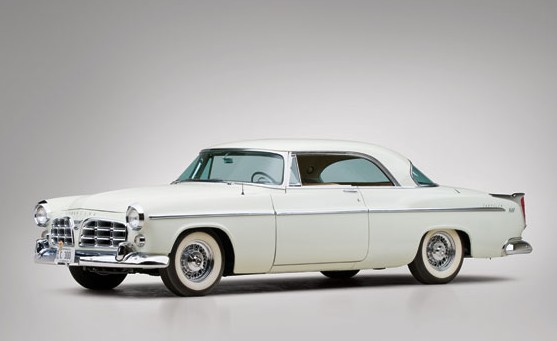
1955 Chrysler C-300 Hardtop Coupe
1956 300B Hardtop Coupe

1956 Chrysler 300B Hardtop Coupe
Above images: classicarweekly.net Info below from edmunds.com
Officially offered for sale on February 10, 1955, the first Chrysler 300 was athletic-looking, but it didn’t have a letter at the end of its name. With 300 horsepower aboard, it was among the quickest cars of its time, getting to 60 mph in just 9.8 seconds, according to a test in Mechanix Illustrated by “Uncle Tom” McCahill, who also spurred the car up to a full 130 mph. But beyond being the most powerful production car of its time, the first Chrysler 300 was also among the best handling thanks to a heavy-duty suspension. It was also very luxurious and handsome in a bulky linebacker sort of way.
But the most prominent display of the first 300’s attributes didn’t come in any showroom, but on racetracks around the Southeast. Back in '55, NASCAR stock cars were in fact stock production vehicles and, except for some crude safety equipment and numbers on the doors, almost indistinguishable from the cars the public could buy. With absolutely no support from Chrysler, Mercury Outboard founder Carl Kiekhaefer campaigned a fleet of white 300s during the 1955 NASCAR Grand National season with drivers like the Flock brothers (Tim, Fonty and Bob) and Norm Nelson behind the wheel.
The Kiekhaefer 300s were spectacularly dominant and overwhelmed the factory-backed Chevrolets and Fords. Tim Flock took the driver’s championship while winning 18 of the 38 races he entered and finishing in the top five an astounding 32 times. His brother, Fonty, took another three victories, while Chrysler campaigner Lee Petty took home three trophies. Suddenly, the 300 had a glorious racing heritage.
Considering the short model year for that first 300 (only 1,725 were sold at a thick $4,109 base price), it was no surprise that the 1956 300 was pretty much a carryover machine. Actually, the easiest way to tell the '56 300 from the '55 was that it now wore the name “300-B” as the tradition of labeling each subsequent model year with the next letter of the alphabet began.
Beyond that name modification and new taillights, the 300-B also featured the latest version of the Hemi V8, now displacing 354 cubic inches and making 340 hp. Plus, there was now an optional version featuring a 10.0-to-1 compression ratio that was rated at an almost unfathomable 355 hp. Success on the racetrack continued, but sales actually softened a bit to just 1,102 units.
Even by the standards of the mid-'50s, the entire Chrysler range of cars looked a little dowdy. If the 300 were to prosper, it had to get looks to match its performance.
1957 300C Hardtop Coupe

image: examiner.com
Second Generation: 1957-1959
Virgil Exner, then Chrysler’s design chief, called his new styling direction that was seen on all the 1957 Chryslers “Sweptline,” in reference to the upswept tailfins that adorned the cars’ rear flanks. And the car that best exemplified the new look was the new 300-C. This car wasn’t just gorgeous, but glamorous. From its Ferrari-like grille to the plump rear fins, the 300-C exuded sex appeal in a way no domestic car had before it. The original 300-C is still considered by many to be the most beautiful and desirable 300 of them all.
More than just the sheet metal was new, as Chrysler put a whole new chassis under its cars for '57, featuring a torsion bar front suspension. And the Hemi itself had grown to 392 cubic inches (6.4 liters) and was now available in 375- and 390-hp versions. Most 300-Cs came equipped with Chrysler’s TorqueFlite push-button automatic transmission, but the 390-hp version was usually paired with a three-speed manual transmission. The 300-C was also the first 300 available as a convertible.
Stuffed with more leather than ever before and wearing a new circular badge that would become a 300-series trademark, the base price of the 300-C hardtop ($4,929) was almost $700 more than that of the 300-B. But that hardly mattered, as this radically more attractive machine found 2,402 buyers — 484 of them opting for convertibles. The first two years of the 300 may have established the marque’s performance credentials, but it was the 300-C that gave the car an aura of greatness.
Chrysler didn’t do much to create the 1958 300-D, other than modify the '57 hardtop’s windshield slightly, throw some red paint on the hubcaps and offer Bendix’s electronic fuel injection system as an option. Unfortunately, electronic fuel injection wasn’t a great idea in an era when vacuum tubes still ruled the electronics world, and the 16 or so cars equipped with the Bendix system were recalled and retrofitted with carburetors. The single engine that remained, a 392-cubic-inch Hemi wearing dual Carter four-barrel carbs, made 380 hp.
“Once moving, the 300’s huge 9.00-by-14 nylons slap at tar strips with solid authority,” wrote the Motor Trend editors about the 300-D. “The low-speed ride is rough on city streets, solid on highways up to 85 or so and just right at anything you can run over that. There’s no body or chassis vibration from either engine or suspension…. The entire package is an impressively engineered, confident automobile that knows it’s good — and soon let’s you know it, too.” In spite of the accolades, production dropped to 618 hardtops and 191 convertibles that year.
And that was it for the Hemi engine in the 300 for the next 47 years.
While the 1959 300-E looked much like the 300-D (except for a new grille texture and, of course, the modified badges), Chrysler fitted it with a 413-cubic-inch (6.8-liter) “Wedge” head V8. Swapping the Hemi’s hemispherical combustion chambers for the Wedge’s wedge-shaped ones didn’t change the 380 hp available to buyers (the induction system remained dual Carter four-barrels), but it did provide additional torque lower in the power band. Just 550 hardtop and 140 convertible 300-Es found homes that year.
What was next for the 300 was a whole new way of building Chryslers.
1960 300F Hardtop Coupe

image above: collectorcarads.com
1962 300H Hardtop coupe
image: refinedguy.com
Third Generation: 1960-1962
All the new 1960 Chryslers looked different, and they truly were as the corporation adopted unibody construction techniques for all its full-size cars. So the 300-F would be the first 300 to lack a traditional ladder frame underneath it.
The relatively elegant styling of the 300-C, -D and -E was tossed aside with the 300-F, as it adopted some of the most flamboyant styling ever seen outside the Ringling Brothers big top. The tail fins were now razor-thin and ended in a point that looked ready to impale pedestrians. The flat trunk lid between the fins featured the impression of a spare tire. And up front, there was a spectacular, yet tastefully simple, grille with just two thin chrome bars intersecting at the grille’s center.
Matching the over-the-top exterior, the 300-F’s interior featured four individual bucket seats with a center console running the length of the cockpit between them. The “Astradome” instrumentation put a 150-mph speedometer under a large, clear plastic dome with subordinate gauges in their own smaller domes.
But the sheer spectacle of the 300-F didn’t stop there. In the engine bay, the 413 Wedge V8 now featured an exotic “Ram-Tuned” long runner intake manifold that placed each Carter carb outboard of the engine itself, feeding the opposite bank of cylinders. The throttle linkage alone had the intimidating intricacy of a Swiss watch. Power was now pegged at 375 hp in most 300-Fs, with a very few vehicles getting a higher-compression version making 400 hp. Nearly all cars were equipped with the Torqueflite three-speed automatic, but a handful (maybe four) had a French-made “Pont-A-Mousson” four-speed manual. Production rose to 964 hardtops and 248 convertibles.
Except for modified styling that included headlights stacked inside slanted housings, the 1961 300-G was very much a carryover from the 300-F. Still, production climbed to 1,280 hardtops and 337 convertibles.
Things got confusing for 1962, as the 300 was now available in two distinct series. First was the traditional “Letter Series” car now called, naturally, the 300-H, which lost the massive tail fins of previous years but was otherwise a rerun of the 300-G. Then, there was the new 300 “Sport Series,” which essentially replaced the Windsor in Chrysler’s lineup and included the first four-doors (hardtop and pillared sedan) to carry the 300 name. The Sport Series carried over the Letter Series grille and styling cues but used a revised version of the lower-line Newport interior. And while the 300-H still had the 413 under its hood (once again rated at 380 hp), the Sport Series packed the relatively lackluster 383-cubic-inch (6.3-liter) V8, making just 305 hp while breathing through a single two-barrel carb.
There are other significant generations of Chrysler 300 Letter cars that came later, but I feel these later cars were aimed at appealing
more toward the traditonal luxury market, who believed that performance is good, but it was secondary to comfort, ride, features, and style.
Things that are key to what is generally considered as trademarks of luxury.
But most importantly, they were brought back, and now adhere to the original creed of performance and luxury in equal measures.
In FAPSD, and FM4, they still live on…
2009 Chrysler 300 STR8 with 425 hp. Capable of 13 sec 1/4 mile e.t.

2012 Chrysler 300C SRT8 with 470 hp hemi. Capable of very low 13 sec 1/4 e.t.

Metaphorically speaking: Who said that just because the guy wears a suit (a 4-door) , he still cant knock you out?
^
Repost:
HISTORY
Back to the old school factory performance…today we will feature:
THE FABULOUS HUDSON HORNET!
First generation (51-54)1951
Hudson Hornets were available as a two-door coupe, four-door sedan, a convertible and a hardtop coupe. The models were priced the same as Commodore Eight, which was priced from US$2,543 to $3,099.
All Hornets from 1951 to 1953 were powered by Hudson’s high-compression straight-six “H-145” engine. In 1954, power was increased to 170 hp (127 kW) from 145 hp (108 kW). Starting in 1952 an optional “twin-H” or twin one barrel carburetor setup was available at additional cost. A L-head (flathead or sidevalve) design, at 308 cu in (5.0 L) it was the “largest [displacement] six-cylinder engine in the world” at the time. It had a two-barrel carburetor and produced 145 hp (108 kW)[3] at 3800 rpm and 275 lb·ft (373 N·m) of torque.Devil The engine was capable of far more power in the hands of precision tuners, including Marshall Teague, who claimed he could get 112 miles per hour (180.2 km/h) from an AAA- or NASCAR-certified stock Hornet, as well as Hudson engineers who developed “severe usage” options (thinly disguised racing parts).[7] The combination of the Hudson engine with overall road-ability of the Hornets, plus the fact these cars were over engineered and over built, made them unbeatable in competition on the dirt and the very few paved tracks of the 1950s.Music The newly introduced “Twin H-Power” was available in November 1951 as a Dealer installed option at the cost of $85.60. An electric clock was standard.[3]
Hudson Hornet 1951 model year production totaled 43,656 units.
1952
In 1952 the “Twin H-Power” version now standard equipment with dual single-barrel carburetors atop a dual-intake manifold, and power rose to170 hp (127 kW; 172 PS). The hood featured a functional scoop that ducts cold air to the carburetors and was considered “ventilation” in 1954, rather than ram air.[1] The engine could be tuned to produce 210 hp (157 kW) when equipped with the “7-X” modifications that Hudson introduced later.Devil During 1952 and 1953 the Hornet received minor cosmetic enhancements, and still closely resembled the Commodore of 1948.
The Hornet proved to be nearly invincible in stock-car racing.[7] “Drinksespite its racing successes…sales began to languish.”[5] Hudson’s competitors, using separate body-on-frame designs, could change the look of their models on a yearly basis without expensive chassis alterations"[5] whereas the Hornet’s “modern, sophisticated unibody design was expensive to update,” so it “was essentially locked in” and "suffered against the planned obsolescence of the Big Three [General Motors, Ford, and Chrysler] automakers.
Hudson Hornet 1952 model year production totaled 35,921 units.
1953
The 1953 model year brought minor changes to the Hudson Hornet. The front end was modified with a new grille and a non-functional air scoop hood ornament.[9]
Hudson Hornet 1953 model year production totaled 27,208 units. An 8-tube radio was a $100 option.[10]
1954

Hudson Hornet “Twin H-Power” engine
Eventually, for the 1954 model year, the model underwent a major square-lined redesign. This entailed extensive retooling because of the way the step-down frame wrapped around the passenger compartment. The front had a simpler grille that complemented the now-functional hood scoop and a new one-piece curved windshield, while the sides gained period-typical fender chrome accents, and the formerly sloped rear end was squared off.[11] The front to rear fender line was styled to make the car look longer and taillamps were also redesigned.[12] The interior was also updated with a new dash and instrument cluster that were surprisingly modern.[11]
There was still no V8 engine available, but the 308 cu in (5.0 L) six-cylinder in top-line Hornets produced 160 hp (119 kW) and the racing-inspired 170 hp (127 kW; 172 PS) “Twin-H-Power” (7-X) version was optional from the factory.
Although the Hornet’s redesign put it on par with its contemporaries in terms of looks and style, it came too late to boost sales.
The updated Hornet Brougham convertible, the sole convertible available from Hudson, was attractive but overpriced at US$3,288 for a six-cylinder car in 1954.[13]
Hudson Hornet 1954 model year production totaled 24,833 (the final year before the Hudson merger with Nash-Kelvinator).
(info above from wikipedia)

Hudsons Hornets were NASCAR heroes!
Check out this potential FAPSD scenario: Olds Rocket 88 vs Hudson Hornet vs 40 Ford?
I’d like to see that…how bout you?
^
Repost: from 10/20/13
HISTORY
Chevrolet Camaro, RPO Z28: A pictorial history.
(Personal favorites from all five Generations)
Lots of FAPSD cars!
1st Gen; 1967-1969.
1967 Camaro Z/28. Note the lack of rear spoiler; stripes optional, and last year for vented windows (window wings) for GM.
Very rare bird.


1968 Camaro Z/28 RS. Note the lack of vented wing windows, and the optional spoiler. V

1968 Camaro Z/28 w/o spoilers.
A Brief History Of The Camaro Z/28
1969 Camaro Z/28. The first year for the cowl induction hood.
69 z28 camarofor sale 1969 camaro z28 cars chevrolet camaro 1969 black lp0rgiaj For Sale 1969 Camaro Z28 Cars Chevrolet Camaro 1969 Black
1969 Z/28 standard Camaro tailights, which came on all Camaros which did not have the RS option.
Below: 1969 Z/28 RS with optional Endura (painted) front bumper.
RS (Rally Sport) is an appearance/trim option: comprised of the hidden headlights you see below, a different set of tail lights with back up lights mounted below, and chrome trim along the wheel wheels, etc. Also has the optional JL2 cowl induction hood. (Not every 1969 Z28 came with this, you paid extra for it, so its an option)
1969 Z/28 RS tailights

FAPSD photo above.
2nd Gen: 1970 1/2 - 1981.
Most dont know the 1969 model was carried over for several months into calender year 1970 due to a strike. That is why the 1970 is called a 1970 1/2.
1970 1/2 Z/28 with standard “ducktail” rear spoiler.
Many believe the 1970-73 models (which share many features) are the best looking 2nd gen. cars.

1970 1/2 Z/28 with standard front grill
1970 Z/28 RS. Again Rally Sport front end w/different grill. I also prefer the “3-piece” spoiler as an option, and as seen on the yellow car, and is an option on the car in the game (remove the front bumper). The rear 3-piece spoiler angle complements the angle of the front spoiler, and both pieces actually prevent lift up front, and provide some down force in rear. They are functional. (I know from personal use in real life; there is a very noticible difference in handling at higher speeds when these cars have spoilers mounted)
1970 Camaro z/28. FAPSD photo.

Later 2nd gen, aka disco or rubber bumper era.
1979 Z28 Camaro (I have a weak spot for this year).


3rd Gen: 1982-1992 http://htsmall.rickscamaros.com/assets/rfg/images/size/265x265/sku/701337.jpg
1990 Camaro IROC Z-28. FAPSD test and tune participant. The 350 came back as an option.

1992 RS Camaro 25th Anniversary tribute below

(My favorite 3rd Gen is the last year, 1992 Z28; The red car below is the last 3rd Gen. Z28 built)
4th Gen: 1993-2002 (LT1-LS1)
1993 Z28 w/LT1 engine

2002 Camaro Z28 w/LS1 engine. Note the differnce in the front end. These are not to be confused with the Camaro SS. Z28s are slightly less aggressive looking due to the lack of the hood scoop, smaller wheels and tires, and smaller exhaust than the SS models. I will provide the SS story when I do info on factory tuners, such as SLP, who built the SLP SS Camaro, Pontiac Trans-Am and Firehawks.
5th Gen: 2014Camaro Z/28

P.S. Heres the comparo with the Z/28 and Laguna Seca Boss 302 (video)
^
Repost:
HISTORY
The Chrysler pony cars, aka the “E” bodies.
Dodge Challengers and Plymouth Barracudas (work in progress post)
info: from wikipedia
The Dodge Challenger is the name of three different generations of automobiles marketed by the Dodge division of Chrysler. The Dodge Silver Challenger was produced in 1959. From 1970 to 1974, the first generation Dodge Challenger pony car was built using the Chrysler E platform, sharing major components with the Plymouth Barracuda. The second generation, from 1978 to 1983, was a badge engineered Mitsubishi Galant Lambda. The third, and current generation, was introduced in 2008 as a rival to the evolved fifth generation Ford Mustang and the reintroduced fifth generation Chevrolet Camaro.
The first car that carried the Challenger name was the mid-year introduction of a limited edition 1959 Dodge Silver Challenger. This was a six-cylinder or V8 model available only in silver paint and only on a two-door body. It came with extra features at no cost, including premium white wall tires, full wheel covers, electric windshield wipers, as well as an upgraded interior with luxury fabrics and wall-to-wall deep pile carpeting.
1970-1974 Challengers
The Challenger was described in a book about 1960s American cars as Dodge’s “answer to the Mustang and Camaro.” It was one of two Chrysler E-body cars, the other being the slightly smaller Plymouth Barracuda. “Both the Challenger and Barracuda were available in a staggering number of trim and option levels” and were intended “to compete against cars like the Chevrolet Camaro and Ford Mustang, and to do it while offering virtually every engine in Chrysler’s inventory.” However, the Challenger was “a rather late response to the ponycar wave the Ford Mustang had started.” In his book Hemi Muscle Cars, Robert Genat wrote that the Challenger was conceived in the late 1960s as Dodge’s equivalent of the Plymouth Barracuda, and that the Barracuda was designed to compete against the Mustang. The Barracuda was actually the first car in this sporty car segment by a few months, but was quickly overshadowed by the release of the segment defining Mustang (the segment being referred to as “Pony Car”). He added that Chrysler intended the new Dodge as “the most potent ponycar ever,” and positioned it “to compete against the Mercury Cougar and Pontiac Firebird.” Genat also noted that the “Barracuda was intended to compete in the marketplace with the Mustang and Camaro/Firebird, while the Dodge was to be positioned against the Cougar” and other more luxury-type musclecars.
The Challenger’s longer wheelbase, larger dimensions and more luxurious interior were prompted by the launch of the 1967 Mercury Cougar, likewise a bigger, more luxurious and more expensive pony car aimed at affluent young American buyers. The wheelbase, at 110 inches (2,794 mm), was two inches longer than the Barracuda, and the Dodge differed substantially from the Plymouth in its outer sheetmetal, much as the Cougar differed from the shorter-wheelbase Ford Mustang. A/C and a rear window defogger were optional.
Exterior design was done by Carl Cameron, who also did the exterior for the 1966 Dodge Charger. Cameron based the 1970 Challenger grille off an older sketch of his 1966 Charger prototype that was to have a turbine engine. The Charger never got the turbine, but the Challenger got that car’s grille. Although the Challenger was well received by the public (with 76,935 produced for the 1970 model year), it was criticized by the press, and the pony car segment was already declining by the time the Challenger arrived. Sales fell dramatically after 1970, and though sales rose for the 1973 model year with over 27,800 cars being sold, Challenger production ceased midway through the 1974 model year. 165,437 Challengers were sold over this model’s lifespan.
A 1970 Challenger R/T 440 Magnum is the centerpiece of the existentialist 1971 film “Vanishing Point”.

Four hardtop models were offered: Challenger Six, Challenger V8, Challenger T/A (1970 only), and Challenger R/T with a convertible version available only in 1970 and 1971. Although there were no factory-built R/T Challenger convertibles for 1971, the R/T continued as a model with the hardtop body-style. The standard engine on the base model was the 225 cu in (3.7 L) six-cylinder.
The performance model was the R/T (Road/Track), with a 383 CID Magnum V8, rated at 335 bhp (249.8 kW); 300 bhp (223.7 kW) for 1971, due to a drop in compression. The standard transmission was a 3-speed manual. Optional R/T engines were the 375 bhp (279.6 kW) 440 cu in (7.2 L) Magnum, the 390 bhp (290.8 kW) 440 CID Six-Pack and the 425 bhp (316.9 kW) 426 cu in (7.0 L) Hemi. The R/T was available in either the hardtop or convertible. For 1970 only, base hardtop and R/T hardtop models could be ordered with the more luxurious SE specification, which included leather seats, a vinyl roof, a smaller ‘formal’ rear window, and an overhead interior console that contained three warning lights (door ajar, low fuel, and seatbelts). The Challenger R/T came with a Rallye instrument cluster that included a 150 mph (240 km/h) speedometer, an 8,000 rpm tachometer, 1972–1974 tachometer went to 7,000 rpm and an oil pressure gauge. In 1972, the R/T badging was dropped and these models were called “Rallye”, although they were never badged as such. The Rallye model featured a faux brake vent on the fenders. The shaker hood scoop was not available after 1971.

A 1970-only model was the Dodge Challenger T/A (Trans Am) racing homologation car. In order to race in the Sports Car Club of America’s Trans American Sedan Championship Trans Am, Dodge built a street version of its race car (just like Plymouth with its Plymouth 'Cuda AAR) which it called the Dodge Challenger T/A (Trans Am). Although the race cars ran a destroked version of the 340, street versions took the 340 and added a trio of two-barrel carburetors atop an aluminum intake manifold, creating the 340 Six Pack. Dodge rated the 340 Six Pack at 290 bhp (216.3 kW), only 15 bhp (11 kW) more than the original 340 engine (which also had the same rating as the Camaro Z/28 and Ford Boss 302 Mustang). The engine actually made about 320 bhp (238.6 kW). It breathed air through a suitcase sized air scoop molded into the pinned down, hinged matte-black fiberglass hood. Low-restriction dual exhaust ran to the stock muffler location, then reversed direction to exit in chrome tipped “megaphone” outlets in front of the rear wheels. Options included a TorqueFlite automatic or pistol-grip Hurst-shifted four-speed transmission, 3.55:1 or 3.90:1 gears, as well as manual or power steering. Front disc brakes were standard. The special Rallye suspension used heavy duty parts and increased the rate of the rear springs. The T/A was the first U.S. muscle car to fit different size tires front and rear to give a racing stance: E60x15 in the front, and G60x15 in the rear. The modified chamber elevated the tail enough to clear the rear rubber and its side exhaust outlets. Thick dual side stripes, bold ID graphics, a fiberglass ducktail rear spoiler, and a fiberglass front spoiler added to the racing image. The interior was strictly stock Challenger.
Dodge contracted Ray Caldwell’s Autodynamics firm in Marblehead, Massachusetts to run the factory Trans-Am team. Sam Posey drove the No.77 “sub-lime” painted car that Caldwell’s team built from a car taken off a local dealer’s showroom floor. When the No.76 was completed mid-season from a chassis provided by Dan Gurney’s All American Racers, Posey alternated between the two. Both cars ran the final two races, with Posey in the #77. Ronnie Bucknum drove the No.76 at Seattle Washington, and Tony Adamowicz drove it at Riverside, California.
The Challenger T/A’s scored a few top three finishes, but lack of a development budget and the short-lived Keith Black 303 c. i. engines led to Dodge leaving the series at season’s end. .

The street version suffered from severe understeer in fast corners, largely due to the smaller front tires. Only 2,399 T/As were made. A 1971 model using the 340 engine with a 4-barrel carburetor was planned and appeared in advertising, but was not produced since Dodge had left the race series.
Performance 1/4 mile
340 T/A: 14.3 @ 99.5 mph (160.1 km/h) 4-speed with 3.55; it was the same car used on all published tests.
340 4-barrel: 14.8 @ 96mph (154 km/h)
383 2-barrel: 15.1 @ 96 mph (154 km/h)
383 Magnum R/T: 14.3 @ 99 mph (159 km/h)
440 Magnum R/T: 13.8 @ 102 mph (164 km/h)
440 Six-Pack: 13.4 @ 107 mph (172 km/h)
426 Hemi: 13.2 @ 108 mph (174 km/h)
2008-present. 3rd generation
On December 3, 2007, Chrysler started taking deposits for the third-generation Dodge Challenger which debuted on February 6, 2008, simultaneously at the Chicago Auto Show and Philadelphia International Auto Show. Listing at US$40,095, the new version was a 2-door coupe which shared common design elements with the first generation Challenger, despite being significantly longer and taller. The LC chassis is a modified (shortened wheelbase) version of the LX platform that underpins the Dodge Charger (LX), Dodge Magnum, and the Chrysler 300. The LX was developed in America from the previous Chrysler LH platform, which had been designed to allow it to be easily upgraded to rear and all-wheel drive. Many Mercedes components were incorporated, including the Mercedes-Benz W220 S-class control arm front suspension, the Mercedes-Benz W211 E-Class 5-link rear suspension, the W5A580 5-speed automatic, the rear differential, and the ESP system. All (7119) 2008 models were SRT8s and equipped with the 6.1 L (370 cu in) Hemi and a 5-speed AutoStick automatic transmission. The entire 2008 U.S. run of 6,400 cars were pre-sold (many of which for above MSRP), and production commenced on May 8, 2008; Chrysler Canada offered a further 670+ SRTs uniquely badged as the Challenger 500 (paying homage to Charger and Coronet 500s) all of which were shipped to Canadian Dodge dealers. Chrysler of Mexico offered only 100 SRT8s, with a 6.1 liter V8 and 425 brake horsepower (317 kW) (SAE). Chrysler auctioned off two 2008 SRT8s for charity with the first car going for $400,000 and a “B5” Blue No.43 car fetching a winning bid of $228,143.43.
Production of the limited edition 2008 SRT8s ended in July 2008, and production of the expanded 2009 line-up started in early August of the same year. The expanded offering was the same as had been unveiled earlier that spring at the 2008 New York Auto Show. Chrysler debuted the full Dodge Challenger line for 2009, with four different trims – SE, R/T, SRT8, and the SXT in Canada only. In addition to the SRT8, which remained unchanged except for the optional 6 speed manual, the line-up included the previously mentioned SE and SXT which offered the 250 HP 3.5-Liter V6. The R/T hosted a 5.7 Hemi sporting 370 hp (276 kW) and 398 lb·ft (540 N·m) of torque when coupled with the 5 speed automatic, and 375 hp (280 kW) with 404 lb·ft (548 N·m) when matched with the same Tremec 6-speed manual transmission as the SRT8.
For 2010, the vehicle cost $515 to $1,010 more than in 2009. All models received standard stability control and ABS. SE and R/T models were available with additional option packages.
The color HEMI Orange was initially dropped for the 2010 model year, but then re-released later in the model year. Two new color schemes became available for the 2010 model year: Plum Crazy and Detonator Yellow. A third new color, Furious Fuchsia was announced in February 2010. But unlike previous special editions, the Furious Fuchsia version had significant changes to the interior with white leather instead of the usual black seats. Chrysler also made a late-year addition to the 2010 model year with the limited edition Mopar '10 Challenger R/T. These cars, limited to only 500 examples, were metallic pearl black in color with three accent colors (blue, red, silver) of stripes to choose from. In addition, these cars were available with black R/T Classic-style wheels along with a Hurst aftermarket pistol grip shifter, custom badging, Mopar cold air intake for a ten horsepower increase, and a Katzkin-sourced aftermarket interior. Units were built in Brampton, Ontario at the Brampton Assembly Plant and completed at the Mopar Upfit Center in Windsor, Ontario. There were 500 U.S. Units and 100 Canadian units built.
Of the 500 Mopar special edition U.S. examples, 320 had automatic transmissions, 180 had manuals. 255 had blue stripes, 115 had red stripes, and 130 had silver stripes.
The Dodge Challenger received new engines across the lineup for the 2011 model year:
On the 2011 Dodge Challenger SE, a new 3.6-liter Pentastar V6 engine producing 305 bhp (227 kW; 309 PS) and 268 lb·ft (363 N·m) replaced the former 3.5-liter V6.
The R/T received an updated 5.7-liter V8 with cylinder deactivation and variable valve timing, though power remained the same. Further revisions included a new bottom grille cutout and an updated suspension.
The new SRT8’s chin spoiler was enlarged to create more downforce. It resembles the 1970 Challenger R/T. The SRT8 received a new 6.4-liter Hemi V8. The so-called 392 (although its actual size is 391 cu-in.) was officially rated at 470 horsepower (350 kW) and 470 lb·ft (640 N·m) of torque. Dodge engineers said they sacrificed peak horsepower ratings for low-end torque, stating a 90 lb-ft increase over the outgoing 6.1-L (370 c.i.d.) Hemi V8 at 2900 rpm. Two transmissions were offered: a 5-Speed Shiftable Automatic and a 6-speed manual. With the revised 6.4-Liter engine, Chrysler engineers cited a quarter mile (~400 m) time of 12.4 seconds at 110 mph (180 km/h) – bettering the outgoing 6.1-Liter Hemi by 0.8 seconds, although that figure has varied wildly between automotive magazines. Car and Driver tested the 392 at 12.9 seconds at 114 mph (183 km/h) while Motor Trend ran it at 13.0 seconds at 111.3 mph (179.1 km/h) and Edmunds’ number was far closer to Chrysler’s claimed numbers at 12.6 seconds at 112.1 mph (180.4 km/h).
For 2013, a Rallye Redline package is available with Dodge Challenger V6 models. Based on the SXT Plus trim, the Rallye Redline package includes unique exterior accents, Black chrome 20-inch wheels with Redline Red accents, performance suspension and brakes, a 3.06 rear-axle ratio and available Radar Red Nappa leather interior.
Marchionne has confirmed on September 3 that due to high sales figure, the current Challenger will be in production for two more model years. Its unconfirmed replacement is only due to arrive by mid-2015.
The Plymouth Barracuda is a two-door car that was manufactured by the Plymouth division of the Chrysler Corporation from 1964 to 1974.
The first-generation Barracuda, a fastback A-body coupe based on the Plymouth Valiant, had distinctive wraparound back glass and was available from 1964 to 1966.
The second-generation 1967 to 1969 Barracuda, though still Valiant-based, was heavily redesigned. Second-generation A-body cars were available in fastback, notchback, and convertible versions.
The 1970 to 1974 E-body Barracuda, no longer Valiant-based, was available as a coupe and a convertible, both of which were very different from the previous models. The final model year for the Barracuda was 1974.
1964-1966

Automotive trends in the early to mid-1960s had all the U.S. manufacturers looking at making sporty compact cars. Chrysler’s A-body Plymouth Valiant was chosen for the focus of the company’s efforts in this direction.
Ford’s Mustang, which significantly outsold the Barracuda, gave to this type of vehicle its colloquial name “pony car”, but the Barracuda fastback, released on 1 April 1964, pre-dates the Mustang by two weeks.
Plymouth’s executives had wanted to name the car Panda, an idea that was unpopular with the car’s designers. In the end, John Samsen’s suggestion of Barracuda was selected.[4] Powertrains were identical to the Valiant’s, including two versions of Chrysler’s slant-6 six-cylinder engine. The standard-equipment engine had a piston displacement of 170 cu in (2.8 L) and an output of 101 bhp (75 kW); the 225 cu in (3.7 L) option raised the power output to 145 bhp (108 kW).
The highest power option for 1964 was Chrysler’s all-new 273 cu in (4.5 L) LA V8. A compact and relatively light engine equipped with a two-barrel carburetor, it produced 180 bhp (130 kW). The Barracuda sold for a base price of US $2,512.
1964 was not only the first year for the Barracuda, but also the last year for push-button control of the optional Torqueflite automatic transmission, so 1964 models were the only Barracudas so equipped. In 1965, the 225 slant-6 became the base engine for the U.S. market, though the 170 remained the base engine in Canada.
New options were introduced for the Barracuda as the competition among pony cars intensified. The 273 engine was made available as an upgraded Commando version with a four-barrel carburetor, 10.5:1 compression, and a more aggressive camshaft with solid tappets. These and other upgrades increased the engine’s output to 235 bhp (175 kW).
Also in 1965, the Formula ‘S’ package was introduced. It included the Commando V8 engine, suspension upgrades, larger wheels and tires, special emblems, and a tachometer. Disc brakes and factory-installed air conditioning became available after the start of the 1965 model year.
1967-1969

The second-generation Barracuda, now a 108 in (2,743 mm) wheelbase A-body, still shared many components with the Valiant but was fully redesigned with Barracuda-specific sheet metal styling and its own range of models including convertibles as well as fastback and notchback hardtops. In 1967, while the 225 cu in (3.7 L) slant-6 was still the base engine, the V8 options ranged from the two- and four-barrel versions of the 273 cu in (4.5 L) to a seldom-ordered 383 cu in (6.3 L) “B” big-block, the latter available only with the Formula S package.
Also in 1968, Chrysler made approximately fifty fastback Barracudas equipped with the 426 cu in (7.0 L) Hemi for Super Stock drag racing. These cars were assembled by Hurst Performance and featured items such as lightweight Chemcor side glass, fiberglass front fenders, hood scoop, lightweight seats, sound deadener, and other street equipment such as rear seats omitted. An included sticker indicated that the car was not for use on public roads; it could run the quarter-mile in the mid-tens in 1968.
The 1969 version of the 383 engine was upgraded to increase power output to 330 bhp (250 kW), and a new trim package called 'Cuda was released. The 'Cuda, based on the Formula S option, was available with either the 340, 383 and, new for 1969, the 440 Super Commando V8.
1970-1974

The redesign for the 1970 Barracuda removed all its previous commonality with the Valiant. The original fastback design was deleted from the line and the Barracuda now consisted of coupe and convertible models. The all-new model, styled by John E. Herlitz, was built on a shorter, wider version of Chrysler’s existing B platform, called the E-body. Sharing this platform was the newly launched Dodge Challenger; however no sheet metal interchanged between the two cars, and the Challenger, at 110 inches (2,800 mm), had a wheelbase that was 2 inches (51 mm) longer than the Barracuda. The E-body Barracuda was now “able to shake the stigma of ‘economy car’.” Three versions were offered for 1970 and 1971: the base Barracuda (BH), the luxury oriented Gran Coupe (BP), and the sport model 'Cuda (BS). For one year (1971), there also was the Barracuda Coupe, a low-end model which (like other Coupe series Chrysler Corp. offered that year) had a fixed rear passenger window and minor B pillar instead of roll-down rear passenger windows. The high-performance models were marketed as 'Cuda deriving from the 1969 option. The E-body’s engine bay was larger than that of the previous A-body, facilitating the release of Chrysler’s 426 cu in (7.0 L) Hemi for the regular retail market.
For 1970 and 1971, the Barracuda and Barracuda Gran Coupe had two six-cylinder engines available — a new 198 cu in (3.2 L) version of the slant-6, and the 225 — as well as three different V8s: the 318ci, the 383ci with two-barrel carburetor and single exhaust, and the 383ci with four-barrel carburetor and dual exhaust 330 hp (250 kW) SAE gross. The Cuda had the 383ci 335 hp (250 kW) SAE gross (same as Dodge’s 383 Magnum) as the standard engine. It also had the 440ci four-barrel Super Commando, the 440ci six-barrel Super Commando Six Pak, and the 426ci Hemi. The 440- and Hemi-equipped cars received upgraded suspension components and structural reinforcements to help transfer the power to the road.
Repost: )riginal 1/3/13
HISTORY
The Ford Mach 1 Mustang
How about a FAPSD day with all Mach 1 Mustangs? That would be cool, huh?
source: wikipedia
The Ford Mustang Mach 1 was a performance model of the Ford Mustang that was introduced in August 1968 as a 1969 model. The newly restyled 1969 Mustang had three bodystyles, and the Mach 1 package was only available on the Sportsroof version. The Mach 1 title adorned performance styled Mustang offerings until the end of the Mustang II in 1978.
As part of a Ford heritage program, the Mach 1 title returned in 2003 as a high performance version of the Mustang with many visual connections to the originals. Ford discontinued the Mach 1 after the 2004 model year, when the Mustang was once again replaced with a new model.
1969 - 1970
TRIBUTE


1969 was the benchmark year for Ford Mustang in its proliferation of performance names and engines. No less than 6 factory performance Mustang models were available (GT, Boss 302, Boss 429, Shelby GT350, Shelby GT500 and the Mach 1). Additionally, seven variations of V-8s were available in various of the '69–'70 cars with most of these available in the new Mach 1.
Due to the success of the Mach 1, the GT model was discontinued after 1969 following poor sales of just 5,396 units versus the 72,458 sales for the Mach 1.[2] The Mustang would not wear the “GT” badge again until 1982.
The Mach 1 was only available in the ‘Sportsroof’ body style[3] (previously known as the ‘Fastback’) and therefore Ford never offered the Mach 1 as a coupe or convertible although many have been modified and styled to look like a Mach 1 by their owners.
The Mach 1’s original recipe was simple. It started with a V8 powered ‘Sportsroof’ body and added numerous visual and performance enhancing items such as matte black hood treatment with hood pins, hood scoop (including optional Shaker scoop), competition suspension, chrome pop-open gas cap, revised wheels with Goodyear Polyglas tires, chrome exhaust tips (except 351W 2V), deluxe interior, unmissable livery and dealer optional chin spoiler, rear deck spoiler, and rear window louvers.
Standard equipment was a 351 cu in (5.8 L) Windsor (351W) 2V motor with a 3 speed manual transmission, and a 9" 28 spline open rear axle. A 351W 4V was optional as was a 390 cu in (6.4 L) FE, and the huge 428 cu in (7.0 L) Cobra Jet 4V with or without Ramair, and even the introduction of the “drag pack” option with the modified 428 cu in (7.0 L) Super Cobra Jet engine. A 4 speed manual or 3 speed FMX (small block)/C6 (big block) automatic transmission was optional, and the 428SCJ added a cast iron tailshaft in place of the regular aluminum one to the C6. A “traction lok” rear axle was optional, and the 428 CJ/SCJ included a “traction lok” with a 3.91 or 4.30 ratio, 31 spline axle shafts and a nodular case. In 1970, the 3.91 ratio was a “traction-lok”, while the 4:30 ratio was a Detroit locker.
Mach 1s came with upgraded suspension to varying degrees dependent upon powertrain choices. Big block cars had front shock tower reinforcement, thicker sway bars (no rear bar for 69), and heavier springs and shocks. 428 CJ/SCJ 4 speed cars also came with staggered rear shocks. Standard on Mach 1s was a fierce but cosmetic hood scoop that had integrated turn-signal lights mounted in the back. A more functional option was the signature “Shaker hood”, an air scoop mounted directly to the top of the motor, used to collect fresh air and so named for its tendency to “shake” above the rumbling V-8 below. The interior came complete with teak wood grain details, full sound deadening material and high-back sport bucket seats.
The name Mach 1 could not have been more appropriate as in 1969, Performance Buyer’s Digest put a new Mach 1 through its paces at Bonneville, breaking some 295 USAC speed and endurance records.[4]
Ford kept the Mach 1 alive into 1970 and little changed other than the visuals. Revised bucket seats, Magnum 500 wheels, recessed taillights on a black honeycomb rear panel as well as new side and rear badging and striping were the main visual differences. 1970 saw the previous 351W V8 engine options replaced with a new 351 cu in (5.8 L) Cleveland (351C) V8 in either 2V (2-venturi carburetor) or 4V (4-venturi carburetor) versions. The 351C 4V (M code) engine featured 11.0:1 compression and produced 300 bhp (224 kW; 304 PS) at 5400 rpm. This new performance engine incorporated elements learned from the Ford 385 series engine and the Boss 302, particularly the poly-angle combustion chambers with canted valves and the thin-wall casting technology.
1971 - 1973

With Ford’s withdrawal from Trans-Am officially following 1970, the high end Boss 302 and 429 disappeared and were replaced by the large street-oriented Boss 351. The 1971 Mustang was larger in almost every dimension. In 1971 the Mach 1 started with a base engine of the 302ci based Windsor motor, with a 2 barrel carburetor. The lineup of engines included four 351 Cleveland engines: The 2-V, 4-V, the C.J.(Cobra Jet) and H.O.(BOSS 351). The H.O was canceled after mid-year 1971, and shortly thereafter the low-compression 351 ‘Cobra Jet’ became available. The lineup topped out with two 429ci options, the CJ (Cobra Jet) & SCJ (Super Cobra Jet). Mach 1s, as well as all other Mustang models (except the BOSS 351) were optionally available with the CJ and SCJ motors. The SCJ came with a drag pack V or W code rear gears, oil cooler and a different rotating assembly. 429 Super Cobra Jet engines used a Holley 4-barrel carburetor, while the Cobra Jet engines made do with a GM-sourced Rochester Quadra-Jet 4-barrel carburetor.
The early version of 1971 Mustang Mach 1 (without side stripe decals) was featured in the James Bond film, Diamonds Are Forever (1971),Music
In 1972, the 429CJ & SCJ’s were dropped from the lineup, and horsepower dropped across the board. The following year also produced the fewest Mach 1 sales of the 1971-73 generation. There are no major differences in the '71 and '72 Mustangs externally, other than different script on the trunk panel. The only difference externally on the '72 Mach 1 was the deletion of the 71-only pop-open gas cap on the Mach 1 for the standard Mustang twist-on gas cap for '72 Mach 1s. Apparently, the pop-open gas caps were prone to spilling fuel in a rear end collision, so Ford discontinued their use across the board. The 302 was still the base engine, with 2 barrel or 4 barrel 351 Clevelands being the only options in the Mach 1 lineup.
One of the most recognizable as well as popular features of the '71-'73 block-off plates in the scoops, so it was a visual, non-functional item. However, they could be made fully functional on models ordered with the ‘ram-air’ option. This included vacuum controlled ‘flappers’ at each scoop, and a huge fiberglass underhood ‘plenum’ that directed cool, outside air into the carburator for increased performance. The ram-air option included a two-tone hood paint treatment in either ‘matte black’ or ‘argent’ (matte silver), coordinated to the color of the Mach 1 decals and striping. In addition, all ram-air equipped Mustangs of this generation came equipped with big twist-style chrome-plated hood lock pins.
Because of the popularity of the ram-air option, but because of the trouble getting the ram-air option approved for emissions reasons, Ford offered an ‘exterior decor’ option in 1973 that consisted of the two-tone paint treatment and the hood pins, but without the actual functional components of the ‘ram air’ system. The only engine that the functional ‘ram-air’ option was available on in 1973 was the 351 2-V, even though the 351 4-V ‘Cobra Jet’ was optional on every model.
2003-04 Mach 1
TRIBUTE


Ford saw the value of heritage in the Mustang name and as a follow up, sought to revive the Mach 1 name. While similar to the Bullitt in the use of the Cobra’s 13 in (330 mm) Brembo front brakes, unique Tokico gas shocks and struts, and lower and stiffer springs, the Mach 1 received a huge performance gain over the base GT and even the 265 hp (198 kW) Bullitt in the form of a unique variant of the DOHC 32-valve 4.6 Liter Modular V8. Commonly known by Mach 1 owners as an “R” code DOHC, (for the unique VIN engine R code) this all-aluminium engine features the same high flow heads as the 2003–2004 SVT Cobra, 2003–2004 Mercury Marauder, 2003–2005 Lincoln Aviator, and the 2003–2009 Australian Boss 5.4 L V8s (see Ford of Australia Boss 5.4 L), the engine also has intake camshafts sourced from Lincoln’s 5.4 Liter “InTech” V8 to provide more mid-range torque. The Mach 1 engine had a 10.1:1 compression ratio in contrast to the 1999 and 2001 Cobra’s 9.85:1, and the Mach 1 was equipped with a Windsor Aluminum Plant or WAP block unique from the Teksid aluminium blocks used in the 1996–1999 Cobras. The Mach 1 also featured a relatively high redline of 6,800 rpm (5-speed cars) and fuel cut off at 7,050 rpm or 5800 rpm (4-speed automatic). While on paper the 305 hp (228 kW) ratings seem a loss when compared to the 1999 and 2001 SVT Cobras which produced 320 hp (239 kW), in practice the Mach 1 engine produced similar peak horsepower and substantially more torque.
Further differences included the use of Ford’s 8.8-inch (220 mm) solid rear axle with a 3.55 final ratio (As opposed to SVT’s Independent Rear Suspension) also the availability of a 4 speed automatic in addition to the Tremec sourced 5 speed manual. Factory steel “Box” cross section subframe connectors were also added to increase chassis strength for both the added handling and to deal with the prodigious torque over the stock GT. Style wise, the Mach 1 was very distinct from other Mustangs as it drew heavily from the 1970 Mach 1. In addition to the matte black spoiler and hood stripe, flat black chin spoiler, Mach 1 rocker panel stripes and Mach 1 badging on the rear, there were also faux Magnum 500 polished 17x8 alloy wheels. A retro themed interior was included with well bolstered dark grey leather seats featuring 70’s style “Comfort Weave” textures, a 1970s style gauge cluster and a machined aluminium shift ball. An optional 18G interior upgrade package included stainless steel pedals, a 4-Way head restraint, aluminum finished shift boot trim ring and door lock posts, and aluminium look bezels on the dash. The most noticeable difference visually from other Mustangs was the bulging hood with cut-out and the return of a semi-legitimate “Shaker Hood”. While physically identical in placement and function (the scoop is said to be built on the same tooling as the 1970 Mach 1) it only provides a portion of air to the motor routing to the air box ahead of the MAF. It does function well as a cold air “snorkel” and a partial Ram Air at speed.
2004 saw only minor cosmetic changes to the Mach 1. 2004 Mach 1s can be identified by bare aluminium finished valve covers, as opposed to the 2003’s black finished covers. Outside, 2004 Mach 1’s wear 40th anniversary tags ahead of the doors while the 2003 has the traditional Mustang Running Pony and Tri-Color bar. The lone interior change was the deletion of the overhead “cargo net” mounted on the headliner. Despite pre-production rumors, the horsepower and torque ratings were not increased in 2004. Power rating was 305 hp (227 kW) and 320 lb·ft (434 N·m).
Unlike many limited edition cars, 2003 Mach 1 owners had a variety of stand out colors from which to choose. Originally, the cars were offered in Black, Dark Shadow Grey Metallic, Torch Red, Zinc Yellow, Oxford White and the Mach 1–only Azure Blue. In 2004 Zinc Yellow was dropped as an option and replaced with a more vibrant yellow called Screaming Yellow, as well as an all new color called Competition Orange.
With such improvements in power and a relatively light curb weight of 3,380 lb (1,533 kg), the 2003 Mustang Mach 1 posted magazine test numbers that were impressive given its $29,305 price tag. Magazine tests by Motor Trend found numbers from 13.88 seconds at 101.9 mph (164.0 km/h) for the automatic equipped 2003 Mach 1 with a 5.6 seconds 0–60 mph, up to the five speed’s blistering 13.5 seconds at 105 mph (169 km/h) with a 5.2 second 0–60 mph time.[9] All this while maintaining a decent 63.5 mph (102.2 km/h) on a 600-foot (180 m) slalom and 0.85 g’s on the skidpad, though the higher CG of the larger DOHC motor has created a tendency to understeer more than the IRS equipped SVTs and lower CG and lower curb weight Bullitt GTs with the same basic suspension and brakes.[10]
Limited in production, the 2003 and 2004 Mach 1s ended with the New Edge body platform, the discontinuation of the Fox framed unibody, and the introduction of the first new frame design since 1979 the s-197 with 9,652 2003’s[11] and 7,182 2004’s[12] being built, contrary to the Mach 1 originally being advertised as a one year limited run model with production set at 6,500 cars.[13]
Repost: Original post 1/2013
AD
FAPSD SERIES IS COMING BACK FOR 2013!
Well, the Super Bowl will be over soon! Football will be done for 2012!
Most true racers are over the novelty of Forza Horizon and have come back to FM4!
And by the time this season starts up, you should need a break from COD!
What are you gonna do with the spare time you have?
When you’re snowed in and tired of watching the Lifetime Channel with the missus,
what cha gonna do?
Get those factory stock musclecars out of the mothballs, and get ready for
the Season 2 of the FAPSD series!
You know the rules (see page 1), Factory Appearing Pure Stock Drag (FAPSD) is coming back!
“It’s where its at!”
Its the happening place to be!
Its classic showroom stock type drag racing at its best!
True tuners and racers love this series,
Why? Because its not just about who can get down the track quickest, in their mutant, 4wd,
exotic, turbo/supercharged, powered, Lamboultimachespylerrari.
Nope! Not here! No 1/2 miles! No 1 mile racing!
Just pure classic 1/4 mile racing!
Open to all RWD late model and classic musclecars!

Coming soon on Sunday nights in Feb/Mar. 2013!
^ Remember these are reposts. Old Advertisement
^
Repost: Original post 12/12/12
HISTORY/TUNER TOPIC
Camaroboy68SS says:
"Nice! now onto some latebig block muscle,
The 1972 Camaro SS 396!
By 1972 the muscle car was on its way out the door. New EPA emissions regulations had all but killed the big block bad boys of just a few years earlier. Other hammers driving nails into the coffin was insurance premiums for these factory hot rods with big cubes and high horespower this was the first thing that started to hamper the muscle car. Then there was the new system of horsepower rating that flat out dropped horsepower like a rock. Dont forget about the gas crisis that pushed prices over $1 a gallon if you could find a station that had gas. Many on the famous big motor cars were already dead by 1972, the hemi and 440 mopars were gone after 1971, the LS6 454 was a one year wonder in the chevelle and didnt last much longer in the vette, pontiac still had the 455 but was a small shadow of its former self and forget about a ram air package. In the world of camaros 1972 was the curtain call for the Super Sport option that would not be seen again untill 1996. There was still a 396 option but like all the other remaining big blocks its a shadow of it self from just a few years prior.
The 1972 396/402 ci big block was rated at a whopping 240hp and 345ft/lb torque.
The 4 speed was still available as was the rally sport “split bumber” nose. by 1972 the camaro had completly switched to the 3 piece rear spoiler taken from the firebird
The 1972 model year for the camaro was the shortest in its history due to a strike at the plant and also when 1000 of the cars had to be scrapped due to not meeting the new federal bumper saftey.
at the end only 970 big block SS camaros were built in 1972 to quietly end the big block and super sport camaro.

 "
"
Repost: Original post 12/12/12
HISTORY
Big Skki says:
"Oldsmobile’s W-31 350
An aggressive cam, ram-air induction made the Ram Rod run
It must have seemed at least somewhat odd–Oldsmobile, the division heralded for big cars with big, torque-rich engines, offering a hotted-up small-block. High-performance small-blocks were best suited to smaller, lighter cars, like pony cars and compacts…which Oldsmobile wasn’t offering in 1968. The smallest Olds models at that time were the intermediate F-85 and Cutlass, and they’d bulked up beyond their svelte dimensions of a few years prior.

Nonetheless, 1968 saw the first of Oldsmobile’s W-31-option small-block engines, offered under the Ram-Rod 350 moniker. The W-31 was built to make power the way other high-performance small-cube V-8s did: with high-flow induction, aggressive camshaft timing and RPM. The '68 Ram Rod 350 was rated at 325hp and used the same cylinder-head castings as regular 350 engines that year, with a “5” casting number, though fitted with larger 2.00/1.625-inch valves from the 455. The camshaft featured 308 degrees duration, making for a choppy idle that mandated manual brakes due to the resulting low idle vacuum; manual transmission, either a three- or four-speed, was also mandatory. One of the unique W-31 pieces is the harmonic balancer, which is larger and thicker than the standard 350 piece, perhaps to better cope with the junior W’s higher RPM capability.
The W-31 was offered on F-85 Club Coupe, Cutlass Supreme coupe and standard Cutlass coupe for 1968, and brought ram-air induction scoops mounted beneath the front bumper, feeding large tubes that passed through the fenderwells to reach the dual-snorkel air cleaner. Just 742 examples of W-31-powered Oldsmobiles were built that first year.
For 1969, the W-31 option was largely the same, though the Ram Rod 350 decals were gone from the fenders, replaced by small “W-31” decals near the marker lights. The ram-air air cleaner lid still carried the Ram Rod name, and beneath it was essentially the same hardware. The biggest change was the availability of an automatic transmission, which was a specially calibrated version of GM’s new Turbo Hydra-Matic 350. Production climbed slightly to 913 copies, including 26 Cutlass convertibles, which had previously been unavailable with the W-31.
The final year of the little W-machine brought more changes, some that made W-31-equipped cars easier to spot. That was mostly due to the new inclusion of the “OAI” hood (Outside Air Induction), as seen on the '70 4-4-2 with W-30 option. The W-31 also got the same striping as the W-30, and similar die-cast emblems for the fenders. The engine remained mostly the same as the previous two years, though there was a new aluminum intake manifold with “W-350” cast ahead of the carburetor pad, and the cylinder heads carried a “6” casting number. The convertible was gone from the lineup, but Olds still managed to sell a few more W-31s for '70: 1,352 total.
Still, the W-31 was simply not a popular choice in the days before serious concerns over fuel economy, emissions output and insurance premiums; the option was quietly snuffed after 1970, which ironically, was right about the time it might have begun to make more sense. "
^
Repost: Original 12/28/12
HISTORY
Here’s a little more info on the AMC Scrambler.
The 1969 AMC Scrambler.

info source: wikipedia
AMC produced one of the muscle car era’s “most visually arresting examples.” It was a special model, produced during 1969 in collaboration with Hurst Performance, the Hurst SC/Rambler. “Likely the most outrageous musclecar from AMC” with 1,512 built, it was probably the only production model made and promoted for a specificdrag racing class, the National Hot Rod Association (NHRA) F/Stock class.
The SC/Rambler was a true muscle car with zero options and a suggested retail price (MSRP) of less than US $3,000, and it was capable of taking down some much more vaunted cars.
[edit]Equipment
Each Hurst SC/Rambler came equipped with the 315 hp (235 kW; 319 PS) 390 cu in (6.4 L) AMC V8 engine from the AMX that was mated to a four-speed manual transmission (with Hurst shifter), a 3.54:1 “Twin-Grip” limited slip differential, with dual exhaust with Thrush (brand) “glasspacks”, heavy-duty brakes with front discs and a sway bar, as well as strengthened drive train and body components. These included connectors between the front and rear subframes, staggered rear shock absorbers that required a special plate riveted in the trunk pan, as well as brackets for the subframe end of the torque links that bolted to a threaded portion of the subframe.[50] Other body modifications differentiating all Hurst SC/Ramblers from regular hardtop Ramblers included rolling back both the front and rear wheel openings to allow for larger tires. American Motors called on Hurst to develop a “Stock Car” (SC) meaning “original factory” production model - often nicknamed “Scrambler” - to make a strong impact in the compact muscle market segment.
Available only as a two-door hardtop, the interior came in standard gray vinyl upholstered reclining bucket seats, but with red, white, and blue headrests, as well as a Sun (brand) tachometer strapped to the steering column. Outside, however, the SC/Ramblers came with the wildest factory paint jobs ever put on a muscle car. It also featured a box-type hood scoop with “390 CU. IN.” and “AIR” in large letters on both sides of it. If someone missed seeing it, a blue arrow on the hood also pointed towards the air intake. The Scrambler came only in two types of red, white, and blue color schemes (“A” or “B” trims) with no other options available, with the exception of an AM radio.
Many AMC historians claim that American Motors built a lot of 500 “A” scheme SC/Ramblers before switching to the “B” scheme, with 500 “B” models were built before AMC switched the final lot of 512 SC/Ramblers back to the “A” pattern.[53] However, there are “B” scheme cars in the Hurst SC/Rambler registry with very early build dates putting their manufacture among the “A” scheme versions.[50]
Some of the other unique standard items on this model included racing mirrors, anti-hop rear axle links, and two-tone styled wheels with red stripe Goodyear Polyglas tires. American Motors made the SC/Rambler priced to sell at $2,998 (after adjusting for only inflation, equivalent to US $19,000 in 2012dollars) and a serious drag strip performer because in its as-sold condition it could do the quarter mile in the low 14 seconds at about 100 miles per hour (161 km/h).[54]
For example, Road Test magazine reported 14.4 at 100.44 mph and reached 109 miles per hour (175 km/h) without topping out.[55] With a few simple bolt on modifications they would run low 12’s.[53] Modified SC/Ramblers have run the quarter-mile in the 9-second bracket.[55]
Source: muscle car drive and flickr
1969 Hurst Rambler SC 390 Engine

1969 SC Rambler interior dash

